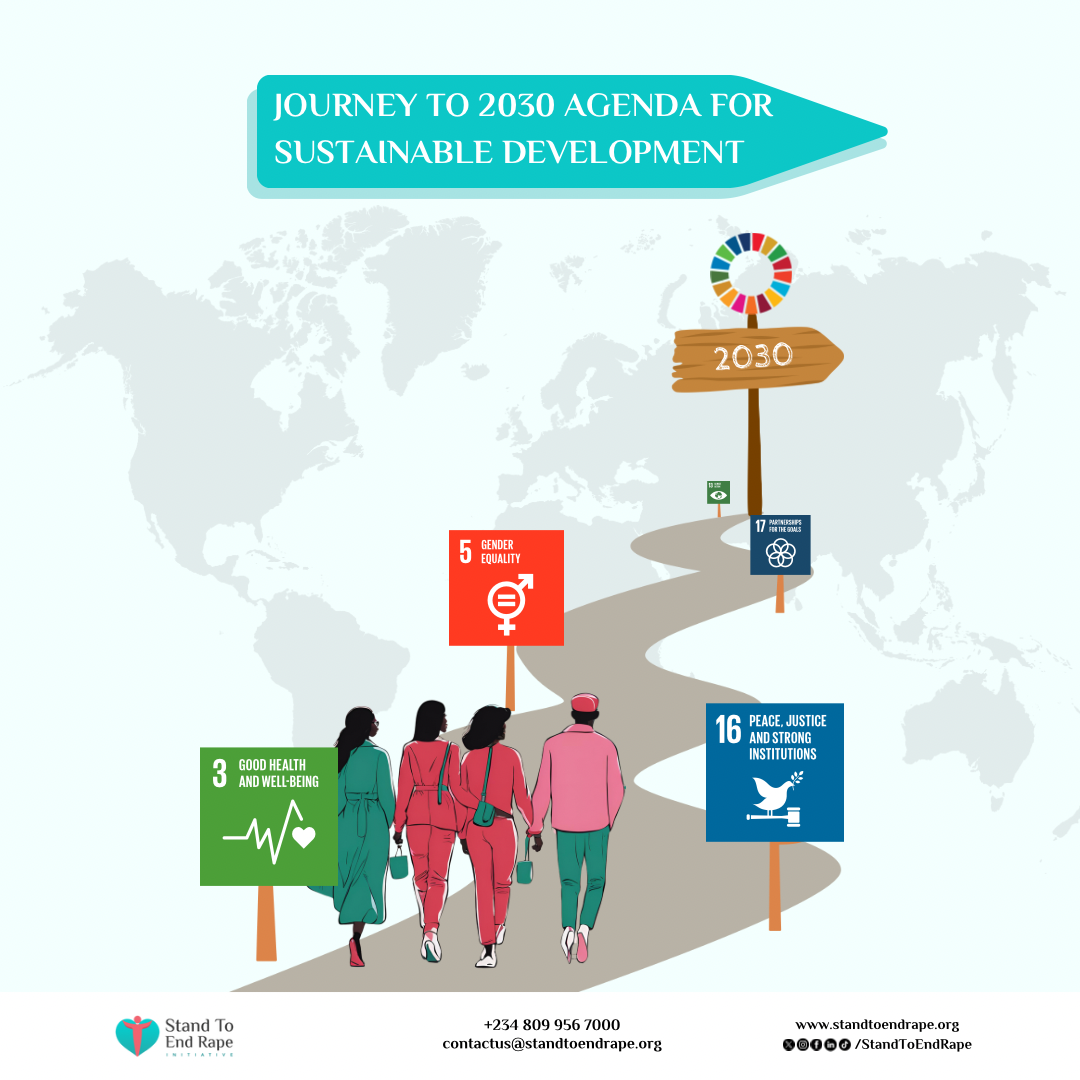

In 2015, the whole world came together to outline a 15-year plan to address major global challenges within a set timeframe to address the most pressing global challenges facing humanity, including poverty, inequality, climate change, environmental degradation, peace and justice and mark achievements. For some individuals, organisations and countries, this timeframe is realistic, to others, not so much. Whichever way you sway, this ambitious deadline serves to create a sense of urgency and accountability for countries, individuals and civil society to work collaboratively toward shared objectives.
The United Nations Sustainable Development Goals (UN SDGs) provide a framework for addressing global challenges such as poverty, inequality, health and injustice.
At Stand To End Rape Initiative (STER), we are deeply committed to advancing the SDGs, particularly those that align with our mission: SDG 3 (Good Health and Well-being), SDG 5 (Gender Equality), and SDG 16 (Peace, Justice and Strong Institutions).
The United Nations’ recently released the Sustainable Development Goals Report. Here is how far the world has come and what we at Stand To End Rape Initiative will has done and will do to contribute to the achievement of these goals.
SDG 3: Good Health and Well-being
According to the 2024 SDG Report, childbirth rates among girls aged 15-19 have seen a downward trend globally, yet Sub-Saharan Africa continues to experience the highest rates, with 97.9 births per 1,000 women aged 15–19 and 4.4 per 1,000 girls aged 10–14 in 2023.
In addition, while the proportion of women of reproductive age (15-49 years) who have their need for family planning met increased slightly from 76.5% in 2015 to 77.6% in 2024 , it still falls short of universal access. By 2030, this figure is projected to reach only 78.2% , leaving 45 million women without access to necessary reproductive health services.
At STER, we recognize that physical healthcare is important, hence the implementation of the Primary Healthcare Project carried out in Kwara State.
However, we understand that comprehensive health and well-being go beyond physical health – it also includes mental health, which is often overlooked in the context of SGBV survivors. To address this gap, we developed a Mental Health Toolkit which is tailored specifically for survivors of sexual and gender-based violence. This toolkit provides practical resources, self-care strategies and guidance on seeking professional help as related to PTSD, Suicidal Ideation, Depression and Anxiety. It is designed to empower survivors to manage their mental health and recover from trauma.
Our commitment does not stop at providing resources. Our Mental Health Support Team plays a vital role in offering direct services to survivors. Our team provides counselling, peer support and referrals to mental health professionals to ensure that survivors have access to the care they need. By integrating mental health support into our broader advocacy and service provision, we are helping to accelerate progress toward SDG 3, especially in regions like Sub-Saharan Africa, where the need is greatest.
SDG 5: Gender Equality
Despite some progress, gender equality remains an elusive goal, particularly in Sub-Saharan Africa. With 70% of all sustainable development goals tied to gender equality, it is clear that achieving SDG 5 is critical to realising the broader vision of a better world by 2030.
One of the biggest obstacles to achieving Gender Equality is sexual and gender-based violence (SGBV). Sadly, we cannot adequately measure progress made globally to reduce this due to insufficient data for all forms of SGBV.
According to the data for child marriage in the SDG Report. It shows that child marriage, while reduced, still affects 1 in 5 girls globally. This is a slight improvement from 25 years ago where 1 in 4 girls faced the risk of Child marriage.
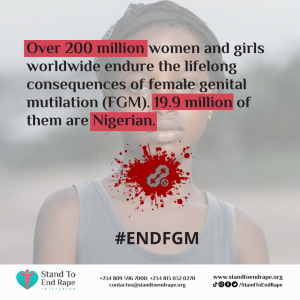
Furthermore, over 200 million girls and women have undergone female genital mutilation (FGM), with 144 million of them in Africa alone and a further 19 million plus in Nigeria. Alarmingly, FGM rates remain as high as 90% in countries like Djibouti, Guinea and Somalia. Gambia’s lawmakers recently voted on reversing the country’s historic ban on FGM which thankfully was unsuccessful.
Legal protections for women are also insufficient, only 20% of the 77 countries surveyed have adequate laws protecting women and just 9 countries have legalised financial resources to support women’s land ownership. This is in-line with the findings that only 14 countries have full legal protection for women by the Women, Business and the Law Report by the World Bank.
Moreover, only 23 countries globally have quotas ensuring women are represented in land administration or management institutions—13 of which are in Sub-Saharan Africa.
To address these persistent challenges, STER is spearheading initiatives that directly contribute to gender equality. Our #PASSVAPPAct Project focuses on the passage and implementation of Violence Against Persons Prohibition Law in Nigeria. This enhances the legal framework for protecting women and girls from violence and providing support mechanisms. By advocating for stronger laws and better enforcement, we are working to ensure that perpetrators of violence are held accountable and survivors receive the support they need to rebuild their lives.
In line with our advocacy efforts, our Scorecard Project systematically evaluates the effectiveness of existing laws and policies related to women’s safety. This project tracks progress, identifies gaps and provides actionable recommendations for policymakers. By doing so, we are contributing to a safer environment for women and girls, aligning our efforts with the broader goal of achieving gender equality.
To address the challenges of women’s participation in politics, we carried out a research project on how violence affects women’s participation in politics. We found that 41% of respondents who are directly involved in Nigerian politics have been sexually harassed at some point in their political career. To ensure that women are better protected globally, international and regional human rights treaties such as the CEDAW and the Maputo Protocol should be domesticated and implemented.
SDG 16: Peace, Justice and Strong Institutions
The SDG Report highlighted the challenges in achieving peace and justice, particularly in conflict-affected regions. As of May 2024, the number of forcibly displaced people globally reached an unprecedented 120 million.
Furthermore, the number of women killed in conflict increased for the first time since 2015. For every 10 civilians killed in conflict, 4 are women and 3 are children.
We are acutely aware of the intersection between violence, displacement and gender. To promote peace and justice, we are focusing on legislative reforms that ensure women’s full participation in political and public life. One of our key initiatives in this regard is our advocacy for the Reserve Bill in Nigeria. This bill seeks to reserve a percentage of legislative seats for women to ensure that women have a meaningful voice in the political process. By increasing women’s representation in decision-making bodies, we aim to create stronger institutions that reflect the needs and rights of all citizens.
In addition to our work on the Reserve Bill, STER actively engaged in building the capacities of and supporting women leaders at various levels of governance. We believe that empowering women to participate in politics is important for building strong and effective institutions that can address gender issues, the root causes of violence and inequality.
Conclusion: A Call to Action
As we approach the 2030 deadline for the Sustainable Development Goals, it is clear that there are major hurdles to overcome, particularly in the areas of health, gender equality and justice.
Through targeted work like our Mental Health Toolkit, #PASSVAPPAct Project, Scorecard Project and advocacy for the Reserve Bill, we are making meaningful contributions to these global goals. We are also partnering with other organisations in line with SDG 17 (Partnership for the Goals).
However, we cannot achieve these goals alone. We need your support to drive more action and sustain efforts.
Join us in this journey to ensure that by 2030, we have made tangible progress toward achieving the Sustainable Development Goals and creating a better future for everyone.
Donate now to support our work.
Read the full report here.

